
California is where most of the modern cannabis gene pool was assembled — the OGs of the south, the Cookies family out of the Bay, the Sherbet and Gelato lines, and the candy-terp generation built on Zkittlez, Runtz and Wedding Cake. It is also the state where a cultivator's genetics decision is most consequential: the same cut that stacks in a sealed Los Angeles room can rot in a Humboldt October. This guide is for growers choosing cultivars for California conditions, written by a Sonoma County nursery that has propagated for the state's farms since 2003.
The cultivar families that define the state
- OG Kush and the California OGs. The Southern California backbone — SFV OG, King Louis OG and their relatives: fuel and pine terpenes, dense indica structure, dependable in warm indoor rooms. Encyclopedia: OG Kush.
- Cookies and Cherry Pie. Girl Scout Cookies out of the Bay Area and its crosses reshaped bag appeal and potency; Wedding Cake (GSC × Cherry Pie, Seed Junky) is the most important commercial descendant and a parent in our own #34 and Tree Flip. Encyclopedia: Girl Scout Cookies, Wedding Cake.
- Sherbet and Gelato. Sunset Sherbet × Thin Mint GSC gave the state Gelato and everything downstream — Lemon Cherry Gelato on our menu; encyclopedia: Gelato.
- The candy generation: Zkittlez, Runtz, Punch. Fruit-forward terpenes, purple expression and heavy resin. Our Zlurpee (Zkittlez × Purple Punch), Candiez, Jolly Rancherz, Stunna Runtz, Caked Up Candy and Banana Ice Pop all live here. Encyclopedia: Zkittlez, Runtz.
- Glue, Mints and the modern hybrids. GG#4 descendants like White Truffle and Donkey Kong; Animal Mints lines like Pablo's Revenge; Chimera crosses like Permanent Chimera and Cobra Chi; and MAC 1.
The genetics network maps how these families connect across 29 menu strains and hundreds of encyclopedia entries.
The breeders behind California's genetics
California's gene pool was built by a relatively small number of breeders whose work is now grown everywhere. On our menu you will find cuts from Seed Junky Genetics (Wedding Cake), Capulator (MAC 1), Backpackboyz (Lemon Cherry Gelato), Tiki Madman (Oreoz Blizzard, Pablo's Revenge), BeLeaf Cannabis (White Truffle, Cobra Chi, Cakemera #12), Lovin' in Her Eyes (Banana Ice Pop), Rasta Cruz Farms (Lemon Mash, Tree Flip) and The Keep Motive (Candiez), alongside our own in-house selections from Relentless Genetics seed and Prime Cuts originals. How each cut is sourced and documented is on the breeder-certified genetics page; profiles of the breeders themselves are in cannabis breeders and genetics.
Matching genetics to California environments
- Sealed indoor (statewide). Anything on the menu will finish; choose for market — candy terps and bag appeal for flower, resin-heavy cuts for extraction. Cycle time matters: most of our menu runs 8–9 weeks of flower.
- Greenhouse and light-dep (Central Coast, Valley, North Bay). Fast finishers and mold tolerance win; stretch under natural light is higher than indoors, so plan spacing. See light-dep growing.
- Full-term outdoor, NorCal (Emerald Triangle, Sonoma, Lake). Late-October rain and fog punish dense indica structure; prioritize mold-resistant cultivars that finish by early October. Some of the most in-demand indoor strains (including our own #34) are wrong for this environment and we will say so.
- Full-term outdoor, SoCal and the southern Valley. Long, dry seasons favor OG structure and heat tolerance; irrigation and heat stress, not mold, are the constraints.
The regional differences are covered in NorCal vs. SoCal growing and the California growing calendar.
Clones vs. seeds in California
Seed gives you genetic diversity and no imported pathogens, at the cost of variability — every plant is a different phenotype, which is unworkable for a commercial room that needs uniform canopy and a single harvest date. Clones give you an identical, proven phenotype in every pot, at the cost of trusting your source's pathogen status and provenance. For licensed production in California the industry has settled on clones (or clone-derived teens) for exactly that reason, which is why the sourcing questions on this site — testing, provenance — matter more than the strain name. Deeper comparison: clones vs. seeds, tissue culture vs. clones.
Sourcing verified genetics
Whatever nursery you use, the checklist is the same: documented lineage for every cut, recurring PCR testing of every mother plant for Hop Latent Viroid, quarantine of incoming genetics, and an inventory that reflects what is actually rooted. Ours is published: genetics menu, live inventory, testing protocol. Licensed cultivators anywhere in California can order by calling or texting (707) 494-5197.
Related genetics on our menu
Availability reads from the same inventory as live inventory (as of Oct 22, 2026).
 In stock · 215 talls
SFV OG
Unknown · Indica · 8-9 weeks
 In stock · 250 fresh · 400 talls
Wedding Cake
Seed Junky Genetics · Hybrid · 8-9 weeks
 Not scheduled
Lemon Cherry Gelato
Backpackboyz · Hybrid · 8-9 weeks
 Not scheduled
Candiez
The Keep Motive · Hybrid · 8-9 weeks
 Not scheduled
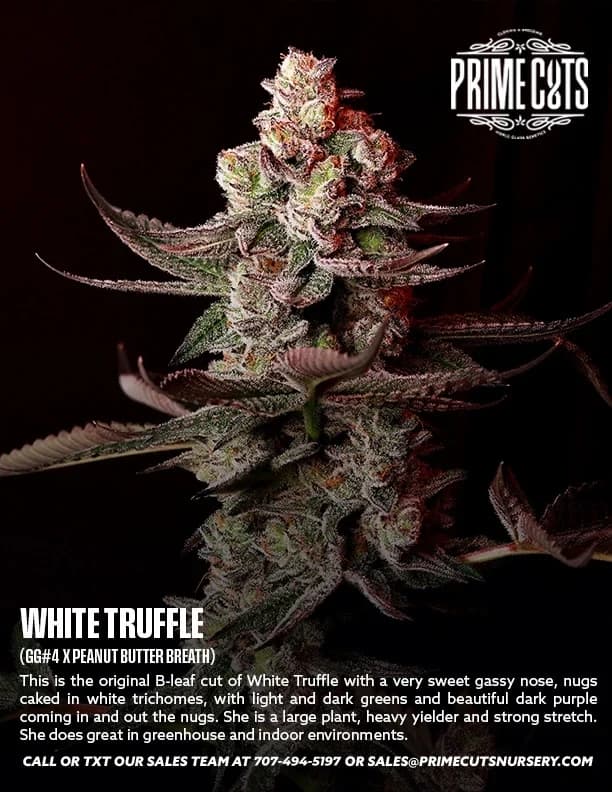
White Truffle
BeLeaf Cannabis (original selected cut) · Hybrid · 8-9 weeks
 Not scheduled
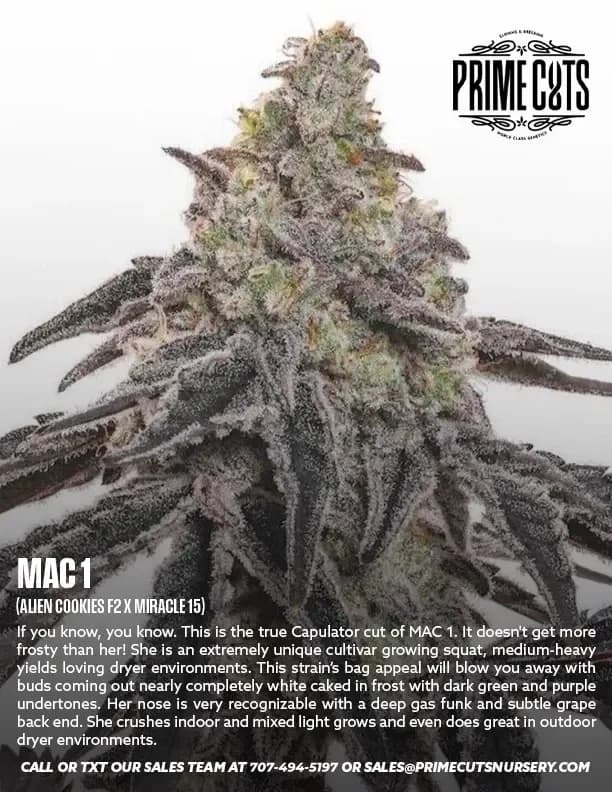
MAC 1
Capulator · Hybrid · 8-9 weeks
Frequently asked questions
What are the most important cannabis genetics from California?
The OG Kush family (SFV OG, King Louis OG), the Cookies/Cherry Pie family and its descendant Wedding Cake, the Sherbet/Gelato line, and the candy-terp generation built on Zkittlez, Runtz and Purple Punch. Modern hybrids from GG#4, Animal Mints and Chimera round out most commercial menus.
Which genetics grow best outdoors in Northern California?
Mold-tolerant cultivars that finish by early October. Dense indica-structured indoor strains are the usual failure; ask your nursery which cuts they have seen finish clean in a wet fall.
Which genetics suit Southern California?
OG-structured, heat-tolerant cultivars for long dry outdoor seasons; indoors, market-driven choices — candy terps for flower, resin-heavy cuts for extraction.
Are clones or seeds better for a licensed California grow?
Clones (or clone-derived teens) for uniformity and a single harvest date; seed for breeding or pheno-hunting. The trade-off is that clones require a trusted, PCR-tested source.
Where can I verify a strain's lineage?
Our strain encyclopedia documents breeder, parents, terpenes and flowering data for hundreds of cultivars, and the genetics network maps the relationships; each menu strain links to its entry.
Talk to the nursery
Licensed cultivator in California? Call or text with strains, quantities and your target week. Nursery hours Mon–Fri 9am–5pm PT.