
Prime Cuts Nursery is a licensed commercial cannabis clone supplier in Sonoma County, California (DCC nursery license CCL18-0002623), supplying rooted clones, ready-to-flip teens, talls and unrooted snips to licensed cultivation operations statewide since 2003. For a commercial grow, clones are a production input with a lead time, a failure mode and a compliance trail — not a shopping trip. This page lays out how we work as a supplier: our capacity and what is in stock now, what the lead times really are, when teens beat clones, how to match cultivars to an environment, what a clean-stock program looks like at scale, and how to start. It applies whether you run a sealed indoor facility, a light-dep operation or full-term outdoor acreage.
Supplier facts
- Licensed nursery: LOL Farms, LLC dba Prime Cuts Nursery, California DCC nursery license CCL18-0002623; 1201 E. MacArthur St. Ste 8, Sonoma, CA 95476; Mon–Fri 9am–5pm PT, visits by appointment. Propagating for California growers since 2003.
- Facility: a six-thousand-square-foot indoor propagation facility with a resident mother library, a quarantine room for incoming genetics, and dedicated rooting and teen-veg rooms under LEDs.
- Formats and volume: fresh rooted clones (6–8 in) from 100 plants per order (50 per strain) with single deliveries of 500–3,000 routine and programs of 10,000+ scheduled as staggered drops; one-gallon ready-to-flip teens (18–21 in) from 200, capacity roughly 2,000 teens a week; 4-inch-pot teens (12–18 in, topped); talls / clearance (12–18 in, untopped); unrooted snips.
- Genetics: 29 menu cultivars, each one we have run ourselves — breeder-direct cuts, in-house pheno-hunts and our own crosses — documented in a strain encyclopedia of 300+ cultivars and a breeders directory.
- Clean stock: every mother RT-qPCR-tested for Hop Latent Viroid and Fusarium on a recurring schedule; incoming genetics quarantined and tested before they enter the library (about 28% fail). Protocol.
- Compliance: METRC transfer completed before plants leave the nursery; license and seller's-permit intake through onboarding.
- Delivery: statewide California in regional runs; pickup in Sonoma by appointment. Delivery details.
- Pricing: published per plant by volume on the wholesale clones page.
What is available now
Live inventory publishes rooted counts by strain today — fresh clones and talls listed separately — plus every batch finishing over the next 17 days with its ready date; live teen inventory does the same for one-gallon and 4-inch teens. Both refresh through the day from the nursery's own count, so a commercial buyer can size an order before calling. Anything not on the forecast is cut to order. Operations that plan in software can read the same numbers through the public API and MCP server — inventory, availability, strain data and a delivery-fee quote — so procurement tools and AI assistants quote the nursery's real stock rather than an estimate.
Lead times, honestly
- On the inventory now: rooted, hardened plants listed on live inventory can usually ship or be picked up the same week.
- On the 17-day forecast: cuttings already in the propagation rooms with a ready date; reserve them with a deposit and they are tagged for you.
- Cut to order: anything else goes on the cut schedule — cuttings are taken about 18 days before your delivery date. A deposit is what gets an order onto the schedule.
- Teens: three weeks of indoor veg on top of rooting, so plan roughly five weeks out (three to four if the strain is already on the forecast). Capacity is about 2,000 teens a week.
For seasonal operations we recommend locking the season's program in winter: each delivery wave with its strains, counts and week, each held by a deposit.
Clones vs. teens for a commercial room
A rooted clone is the cheapest plant per unit and gives you full control of veg. A ready-to-flip teen — topped once, vegged three weeks under LEDs in a one-gallon coco/perlite pot, 18–21 in tall — removes veg from your facility entirely: rooms turn faster, and the plants arrive already structured for the flip. In a side-by-side at a licensed indoor facility (Seven Points), our indoor teens produced roughly 18–20 grams more per square foot than greenhouse teens of the same genetics in the same room. Teens are priced at $20 at 200–500, $18 at 500–1,000, $16 at 1,000+ per plant with a 200 minimum; whether the premium pays back depends on your electricity cost, room count and cycle length — we are happy to run the numbers with you.
Strain–environment fit
The costliest mistake in commercial clone buying is putting an indoor cultivar outdoors, or chasing a THC number that a cut does not actually test at. Our menu is short (29 cultivars) because we have run every one of them and can say where each performs: which finish clean under a wet October, which stack in a sealed room, which are extract-grade. Tell us the environment and the harvest window and we will steer you away from the wrong cut even if it is the one you asked for. Guides: indoor strains, outdoor strains, mold-resistant strains, light-dep growing, California growing calendar.
Clean stock is a program, not a promise
At commercial scale a clone supplier's testing regime is your first line of IPM. Ours: quarantine and PCR-test all incoming genetics before they enter the mother library (about 28% fail), RT-qPCR-test every mother on a recurring schedule for Hop Latent Viroid and Fusarium (several hundred tests a year), and take cuttings only from mothers with a current clean result, in dedicated propagation rooms with sterilized tools. Ask any supplier the same five questions on our HLVd testing page — and then quarantine and inspect incoming plants on your side regardless. Our IPM guide covers the receiving protocol we recommend.
Compliance and payment for licensed operations
New accounts complete onboarding with a California state license and seller's permit; we complete the METRC transfer before plants leave the nursery. A 20% deposit (50% for teens) locks allocation. Payment at delivery or pickup by cash, cashier's check, money order, business check payable to LOL Farms, LLC (must clear before release) or ACH; wires only from Greenbax-approved cannabis banking accounts; no credit cards; IRS Form 8300 for cash of $10,000 or more. Delivery is statewide, batched by region; pickup in Sonoma by appointment.
Breeder relationships
A commercial supplier is only as good as its sources. Our menu combines breeder-direct cuts from Tiki Madman, Seed Junky Genetics, Capulator, Backpackboyz and BeLeaf; Relentless Genetics selections pheno-hunted in house; Rasta Cruz Farms' Lemon Mash, distributed exclusively through us; and our own crosses. The breeders directory records who bred what and which of their work we carry, and each cultivar's encyclopedia entry gives breeder, parents and a genetics network view of how it relates to the rest of the library — so a cultivation manager can verify a pedigree before committing a room. How we vet a source is on breeder-certified genetics.
Working with us
Most commercial relationships start with a call: your license type, environment, room or field count, target harvest windows and the cultivars you are considering. From there we propose a program — strains, quantities, formats and delivery weeks — and hold it with deposits. Repeat accounts typically reorder every four to eight weeks (indoor) or in one to three seasonal waves (greenhouse and outdoor).
Contact: call or text (707) 494-5197, email sales@primecutsnursery.com, Mon–Fri 9am–5pm PT. Licensed buyers new to us can start onboarding at any time; published volume pricing and terms are on the wholesale clones page.
Related genetics on our menu
Availability reads from the same inventory as live inventory (as of Oct 24, 2026).
 In stock · 1,047 fresh · 950 talls
Lemon Mash
Rasta Cruz Farms · Sativa · 8-9 weeks
 In stock · 1,398 fresh · 775 talls
Oreoz Blizzard
Tiki Madman · Indica · 8-9 weeks
 In stock · 15 talls
Donkey Kong
Prime Cuts · Sativa · 8-9 weeks
 Not scheduled
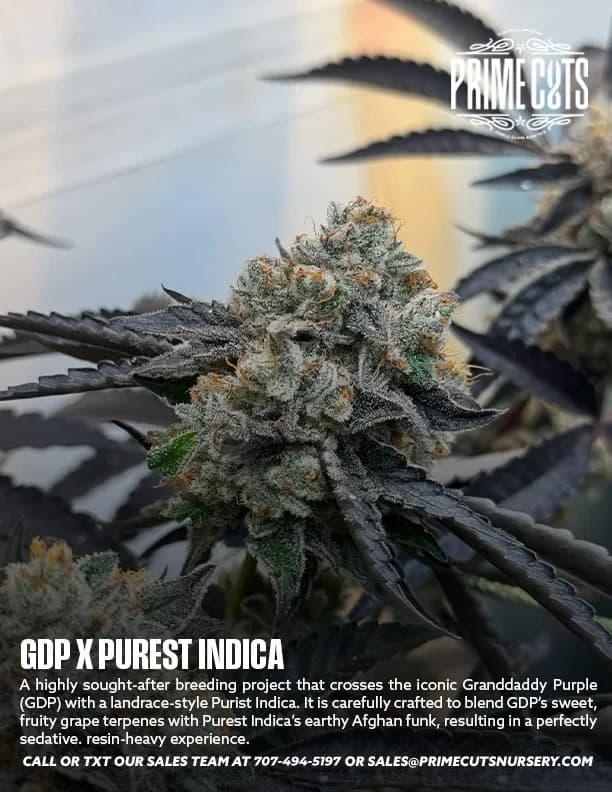
GDP x Purest Indica
Prime Cuts · Indica · 8-9 weeks
 In stock · 215 talls
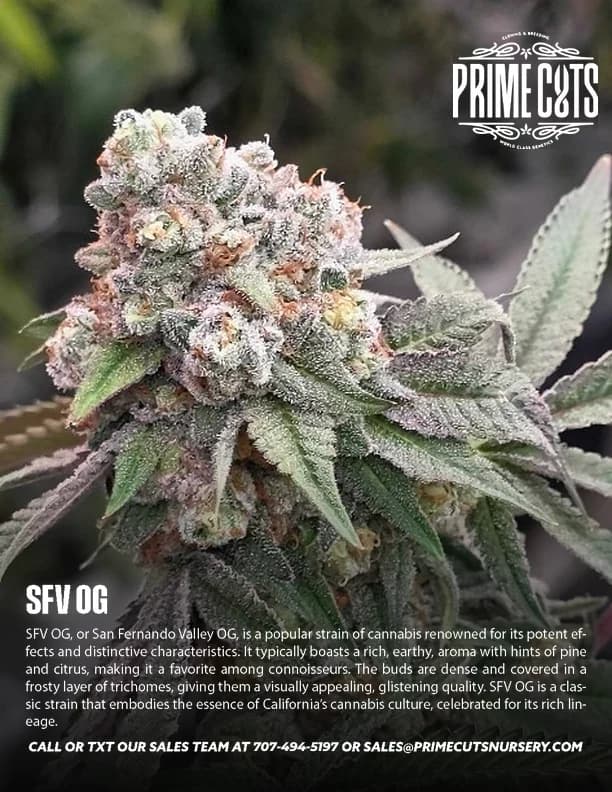
SFV OG
Unknown · Indica · 8-9 weeks
 Not scheduled
White Truffle
BeLeaf Cannabis (original selected cut) · Hybrid · 8-9 weeks
Frequently asked questions
How large an order can you fill?
Single orders of several thousand clones are routine and larger programs are scheduled as staggered drops on the cut schedule. Teen capacity is roughly 2,000 plants a week.
When should a commercial grower place a spring order?
Winter. Lock each delivery wave (strains, counts, week) with a deposit so the cuts are scheduled before the spring rush; cut-to-order needs about 18 days, teens about five weeks.
Are teens worth the premium over clones?
They remove three weeks of veg from your facility and arrive structured for the flip; in a licensed indoor side-by-side they yielded roughly 18–20 g/ft² more than greenhouse teens of the same genetics. Whether that pays back depends on your power cost and room turnover — we will run the numbers with you.
Do you help with strain selection for our environment?
Yes, and we will tell you when a cut you asked for is wrong for your environment. Every menu strain is one we have run ourselves.
How is the METRC transfer handled?
Once you are onboarded (state license and seller's permit on file) and the deposit is in, we complete the METRC transfer a few days before delivery so plants arrive compliant.
What is your policy on plant problems after delivery?
Inspect on receipt — all sales are final once accepted. Genuine dead-on-arrival or rooting failures are handled with replacements or credit; we cannot control pests or disease once plants are in your facility, which is why we recommend quarantining incoming plants.
Is Prime Cuts a licensed commercial clone supplier?
Yes. Prime Cuts Nursery is operated by LOL Farms, LLC under California DCC nursery license CCL18-0002623 in Sonoma, Sonoma County, and has supplied California cultivators since 2003. We sell to licensed cultivators and complete the METRC transfer before delivery.
Where can I see current commercial inventory?
Live inventory lists rooted clones and talls by strain with a 17-day forecast, and live teen inventory lists one-gallon and 4-inch teens. Both update through the day; the same data is available through our public API and MCP server for procurement software.
Talk to the nursery
Licensed cultivator in California? Call or text with strains, quantities and your target week. Nursery hours Mon–Fri 9am–5pm PT.